

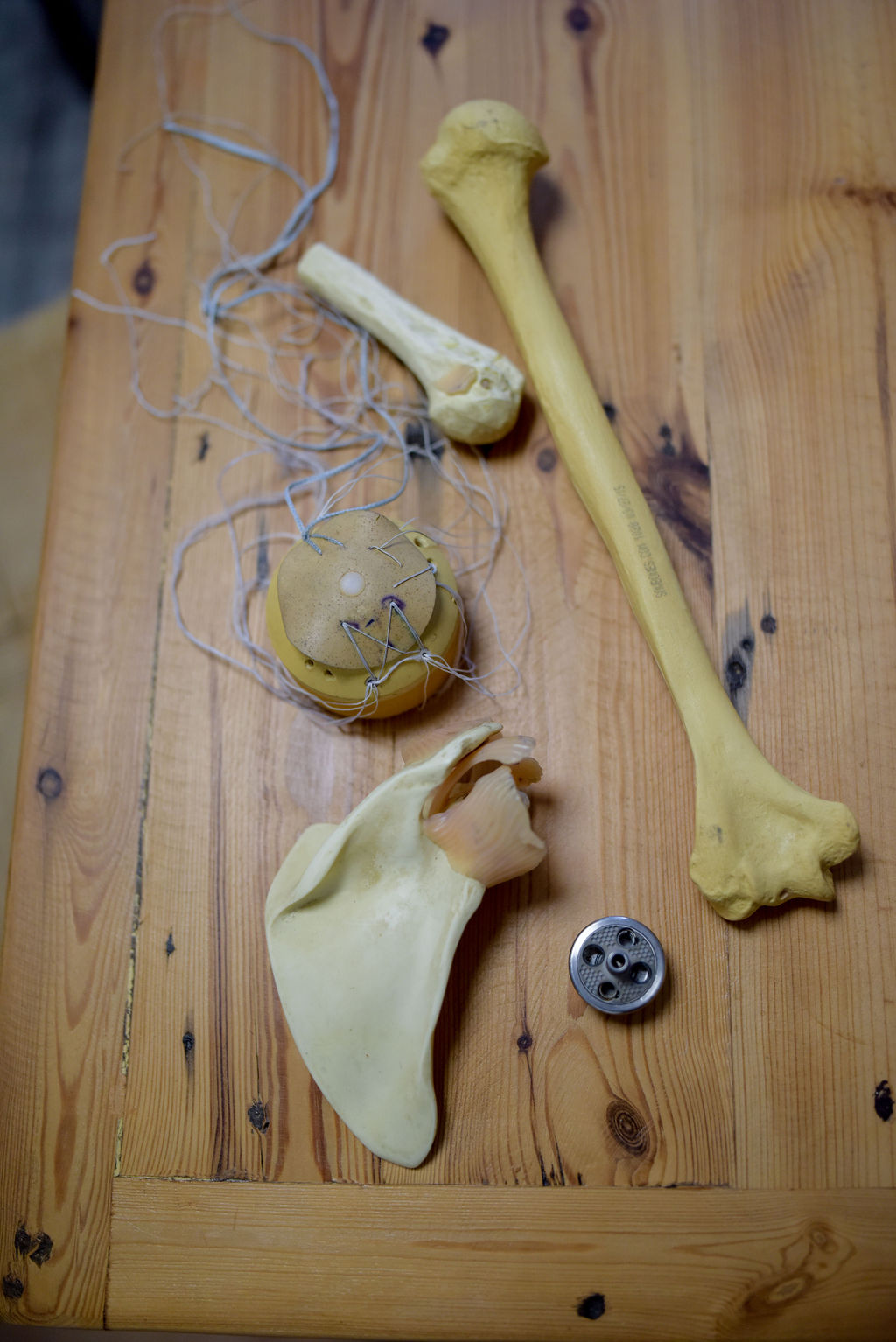
I often see patients with arthritis being diagnosed with a frozen shoulder. While both condition presents with a painful stiff shoulder, a frozen shoulder typically presents in females between the ages of 40-60 years. A normal X-ray would also be present in this age group with a frozen shoulder. I always explain to my patients the treatment of arthritis is like climbing a staircase. You start with NSAIDS and painkillers, then an intra-articular joint injection with corticosteroids and if this does not work and the joint space is preserved an arthroscopic debridement and biceps tenotomy could be of great value. One tries to win time to get the patient to an appropriate age for a shoulder replacement. Pain and loss of function that inhibits the patient’s activities of daily living will be the indicators for replacement surgery. There are different types of replacements available for different types of arthritis in the shoulder. A hemi arthroplasty (only one half of the joint gets replaced) has its limitations but for your young active man with arthritis whom does not respond to pain management this could be an option-

An anatomical shoulder replacement is the prosthesis of choice when the rotator cuff is intact and the wear on the glenoid (socket side) is minimal- this gets evaluated with a CT scan. The ball and socket gets replaced.
Then there is the reverse replacement which worldwide has been the most widely used prosthesis due to the favourable results achieved. It was originally described for patients with torn rotator cuffs where the humerus has migrated superiorly and was riding against the acromion and not in the middle of the glenohumeral head any longer. This type of arthritis is called rotator cuff arthropathy. But we also now use it in cases where the glenoid has been eroded and a B2 glenoid has developed.
